

Introduction: When “Staying Informed” Starts Draining You
We live in a time where information never stops flowing. News updates. Opinions. Reactions. Alerts. Every scroll brings something new, something urgent, something that feels important.
Most of us tell ourselves we’re just staying aware. But if you pause for a second and notice how you feel after consuming all of it, it’s rarely clear. It’s heavy. Mental fatigue. A quiet sense of being overwhelmed without knowing why. This is where information overload begins.
Not when information exists, but when it never stops. And over time, this constant input doesn’t just fill your mind. It starts to reshape how you think, focus, and feel.
What Is Information Overload (Beyond the Definition)
Information overload isn’t just “too much information.” It’s when your brain receives more input than it can process, filter, and make sense of. This includes:
- News cycles that refresh every minute
- Endless social media updates
- Opinions layered on top of facts
- Notifications that demand attention
- Background content that never really stops
The brain is designed to process information in manageable amounts. But today, input is continuous, and often emotionally charged. That’s where the overload begins.
We’re Not Just Consuming More, We’re Absorbing Constantly
This isn’t just a feeling. The numbers reflect it:
- Adults today consume over 11 hours of media daily, including videos, audio, and digital content.
- A large percentage of workers report feeling overwhelmed by information overload, with studies linking high digital consumption to increased stress, anxiety, and even depression.
- Some widely cited research suggests that average attention spans have declined over time in response to digital environments.
- Smartphone users spend 4–5 hours daily on their devices, much of it passive consumption.
This level of input doesn’t just inform us; it shapes us. It keeps the brain constantly processing.
When Awareness Turns Into Overload
Being informed is important. But constant exposure to information, especially stressful or negative updates, comes at a cost.
We scroll to stay aware. But we end up absorbing more than we can hold. One update becomes ten. One opinion becomes a stream of reactions. And before we realise it, we’re not just informed — we’re mentally carrying everything we’ve seen.
The result isn’t awareness. It’s emotional weight. There’s a quiet difference between:
- Knowing what matters
- And consuming everything that appears
That difference is what protects your mental space.
How Constant Input Is Rewiring Your Focus
Your brain adapts to what it experiences repeatedly. When input is constant:
Focus becomes fragmented
You move quickly from one piece of information to another without fully processing any of it.
Depth is replaced with speed
You skim more. You absorb less.
Silence feels uncomfortable
Because the brain is used to stimulation, not stillness.
Read about how constant noise affects mental health and why being alone with your thoughts feels uncomfortable.
Attention span shortens
Quick content trains the mind to expect constant change.
This is how information overload rewires your focus, not suddenly, but gradually.
Why Your Mind Feels Tired
You might not have completed many tasks. But your brain has been working continuously. Processing:
- Headlines
- Emotions
- Comparisons
- Opinions
- Alerts
This constant processing creates mental fatigue. Not the kind that comes from effort, but the kind that comes from too much input without pause.
The Emotional Impact We Don’t Talk About Enough
Information overload doesn’t just affect focus. It affects how you feel.
You feel drained without a clear reason
- Your thoughts feel cluttered
- Small things irritate you more
- You feel mentally “full” but not satisfied
This happens because the brain hasn’t had time to process, filter, and release what it has taken in. When input keeps coming, emotional space keeps shrinking.
Not All Input Is Harmful: The Role of Intention
This is important. Not all sound, content, or information is negative. As explored earlier, intentional input, like structured learning or even practices such as sound therapy, can support calm and clarity when used mindfully.
The problem is not the input itself. It’s constant, unfiltered, and unintentional input. The difference is choice.
Reclaiming Focus Without Cutting Off the World
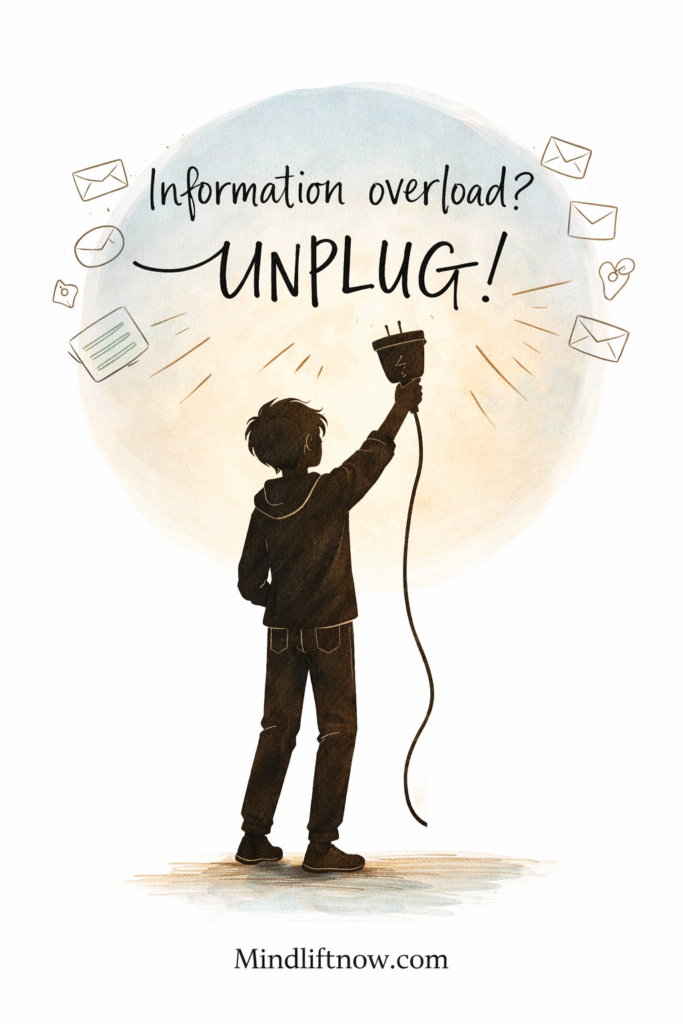
You don’t need to disconnect completely. But you can create space within the noise. Start small:
- Pause before opening another update
- Limit how often you check news or social feeds
- Spend a few minutes without input
- Let your mind sit with what it has already absorbed
You don’t need less information. You need more space between them.
How to Reduce Information Overload (Without Disconnecting Completely)
You don’t need to shut yourself off from the world. But you do need to create space within it. Start here:
1. Reduce unnecessary input
Not everything needs your attention. Limit how often you check the news or social media. You are aware of this, it’s just a matter of practising
2. Create “no-input” moments
Even 5–10 minutes without sound, scrolling, or updates allows your mind to reset. When you feel it’s too much, step away and unplug.
3. Consume with intention
Before opening anything, ask yourself: ‘Do I really need this right now?” That one pause changes everything. The creators use ‘hooks’ to make you watch their videos. But it’s up to you to decide that you don’t have to pay attention to every video.
4. Let your mind process
After consuming information, don’t jump to the next thing immediately. Give your brain time to absorb and release.
5. Protect your mental space
Awareness should not come at the cost of your peace. You’re allowed to step back whenever you feel overwhelmed. Your mind is giving you the signals to act, not to ignore.
Why This Matters Now
We are living in a time where information moves faster than our ability to process it. And when the mind doesn’t get time to rest:
- Focus weakens
- Emotions build up
- Clarity fades
Understanding information overload is not about avoiding the world. It’s about protecting how you experience it.
Final Thoughts: You Don’t Have to Carry Everything
Not everything you read needs to stay with you. Every update does not need your attention. Not every piece of information needs space in your mind. You’re not falling behind by stepping back. You’re making space to think clearly again.
Information will always be there. But your mental clarity depends on what you choose to hold, and what you allow to pass.
At Mind Lift Now, growth isn’t about consuming more. It’s about understanding what truly deserves your attention.
FAQs
It’s when the amount of input exceeds your brain’s ability to process it effectively.
It reduces attention span, increases distraction, and makes deep thinking harder.
No. But constant, unfiltered exposure to information can increase stress and mental fatigue.
Because your brain is processing more than it can manage, even if you’re not actively working.
Create small pauses, limit unnecessary input, and allow your mind time to process what it takes in.