Introduction
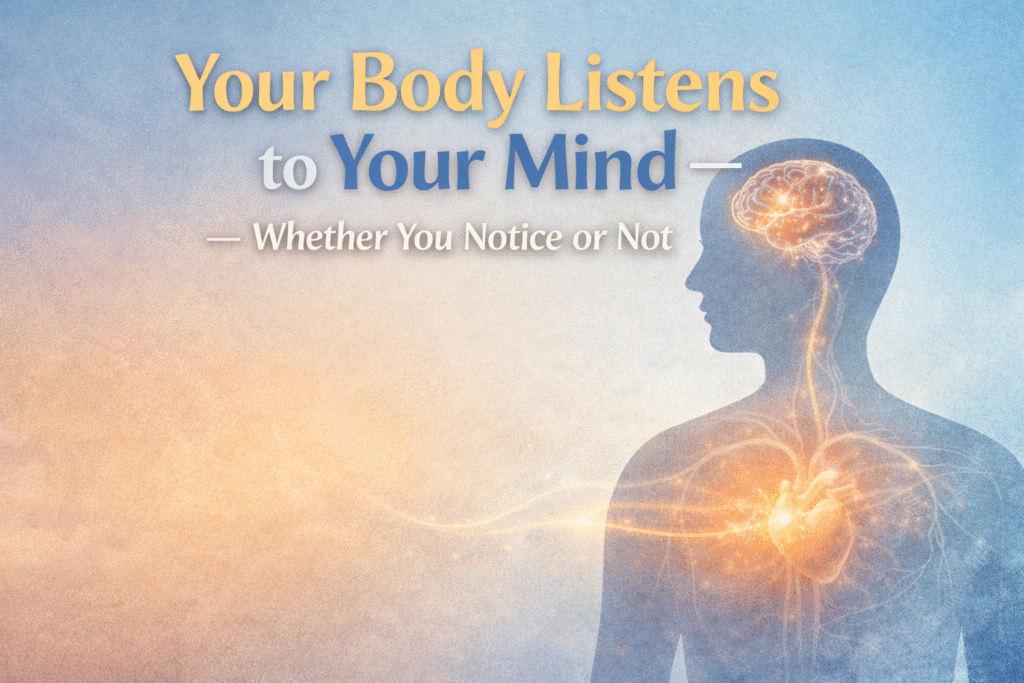
Healing is often spoken about in medical terms – tests, treatments, and timelines. But anyone who has gone through discomfort or illness knows there’s more to it than that. The mind-body connection quietly shapes how we experience pain, recovery, and wellbeing every day.
- How calm you feel.
- How stressed you are.
- Whether you feel supported or constantly tense.
These things quietly shape how the body responds.
This does not mean illness is imagined. It does not mean medical care should be ignored. What science shows is simpler and more human: the mind and body are deeply connected, and this connection influences how we experience pain, recovery, and wellbeing.
This is what the mind-body connection is really about.
What the mind-body connection actually means
In science, the mind-body connection refers to how the brain communicates with the body through:
- The nervous system
- Hormones
- Immune responses
Your thoughts and emotions don’t stay in your head. They affect heart rate, muscle tension, digestion, sleep, and even how the immune system functions.
When the brain senses danger or stress, the body prepares to protect itself. When the brain senses safety and calm, the body shifts into repair mode. Healing happens more easily in the second state.
Stress has a real impact on healing
One of the most consistent findings in health research is the role of stress.
Long-term stress raises cortisol levels. High cortisol can:
- Slow wound healing
- Disrupt sleep
- Increase inflammation
- Weaken immune response
This is why people under constant pressure often feel exhausted and take longer to recover from even minor issues. Reducing stress doesn’t cure conditions. But it creates a better environment for the body to do its work.
Placebo and nocebo: expectation matters
The placebo effect is often misunderstood.
Placebo effect
When people expect improvement, the brain can:
- Reduce pain signals
- Improve symptom perception
- Activate calming pathways
This happens even when the treatment itself has no active ingredient.
Nocebo effect
The opposite of placebo, the nocebo effect is also true.
When people expect harm or feel fear, symptoms can:
- Feel stronger
- Appear faster
- Last longer
These effects are not imaginary. They are physical responses shaped by stress, attention, and belief.
Together, they show one thing clearly: The mind influences how the body experiences healing.
A small, real moment from personal experience.
I noticed this in a quiet moment with my grandmother.
She is elderly and has been experiencing discomfort, including gradual vision issues. I gently applied castor oil on her eyelids for two nights, not as a treatment, but as a soothing routine.
On the third day, I asked if she felt any difference. She paused and said,
“Were you applying it to improve my eyesight? That might be why I feel a bit more clarity now.”
It made me wonder. Did something physical change so quickly? Or did her mind, sensing care and intention, shift how her body perceived discomfort?
This doesn’t mean castor oil can cure eye conditions. Medical guidance is essential. But it does highlight how attention, belief, and emotional safety shape experience.
Mind-body connection does not mean
It’s important to be clear that the mind-body connection does not mean:
- Illness is caused by thoughts
- Positive thinking replaces treatment
- People are responsible for their symptom
Healing is complex. Biology, environment, care, and support all matter. The mind’s role is supportive, not absolute.
Simple ways to support the mind-body connection
You don’t need extreme routines. Small habits make a difference.
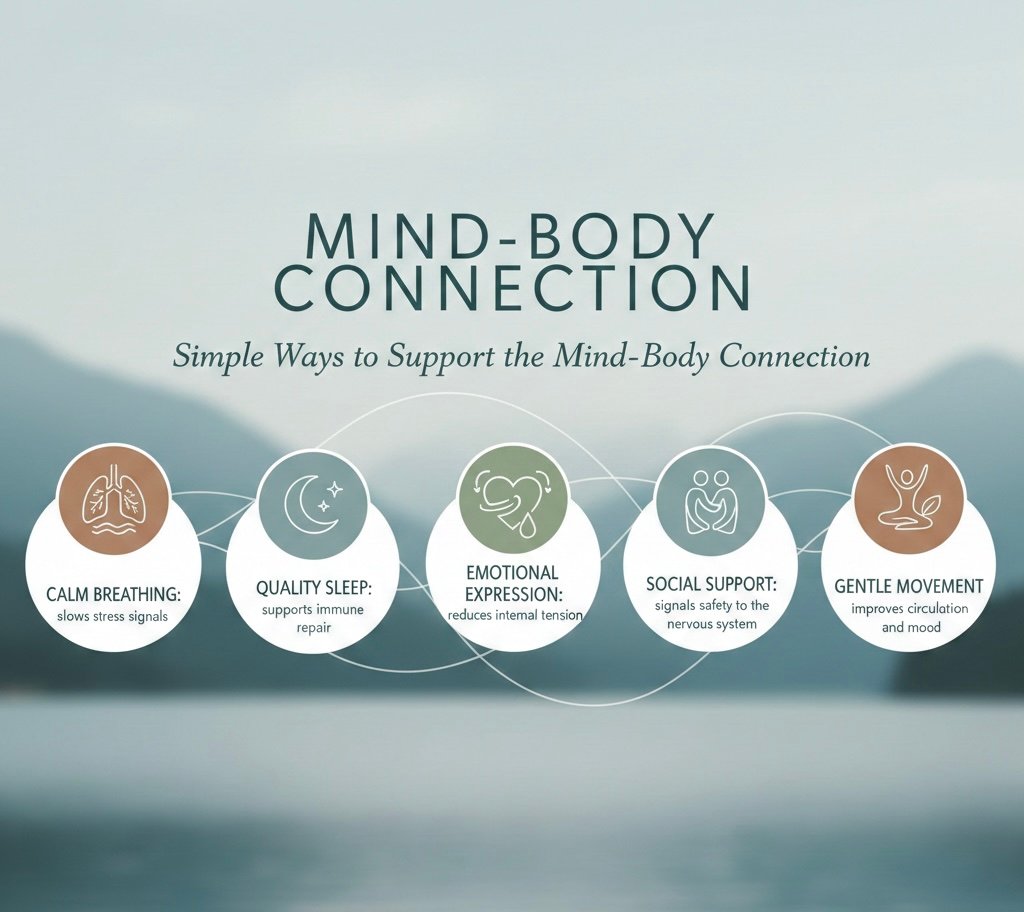
- Calm breathing: slows stress signals
- Quality sleep: supports immune repair
- Emotional expression: reduces internal tension
- Social support: signals safety to the nervous system
- Gentle movement: improves circulation and mood
These don’t heal disease. They support the body while healing happens.
Why this matters in everyday life
When people feel heard, safe, and supported, their bodies respond differently.
They often:
- Tolerate discomfort better
- Recover with less fatigue
- Feel more hopeful and steady
This is the mind body connection in real life – not dramatic, just deeply human.
Final thoughts
Healing is not only about fixing what’s wrong. It’s also about creating the conditions where the body can function at its best.
Science doesn’t separate the mind and body the way we often do. It studies them as a system, connected, responsive, and influenced by daily experiences.
You don’t need to control your thoughts. You only need to be kinder to your nervous system.
That’s where healing often begins.
If you’re exploring personal growth with honesty and balance, Mind Lift Now is a space where clarity comes before pressure.
FAQs
The mind-body connection describes how thoughts, emotions, and stress influence physical processes like immunity, pain perception, and recovery.
Yes, research shows stress and emotional state affect how the body responds to illness and recovery. This supports healing but does not replace medical care.
No. It’s not about forcing positivity. It’s about reducing chronic stress and creating emotional safety.
The placebo effect occurs when positive expectations improve symptoms through real brain-body responses.
The nocebo effect happens when fear or negative expectations worsen symptoms through stress responses.
No. Mindset supports healing but should always be paired with appropriate medical guidance when needed.
Reference:
https://www.mdpi.com/1660-4601/21/3/243
https://www.psychologicalscience.org/observer/placebo-effect