Introduction
We live in a world that glorifies speed, rushing meals, scrolling endlessly, and jumping from one thought to another. But somewhere between all the noise, our body whispers, “slow down.” That’s where mindful living begins.
Mindful living isn’t a trend; it’s a way of coming home to yourself. It’s about living with awareness, noticing your thoughts, breathing consciously, and responding instead of reacting. When you live mindfully, you’re not escaping stress; you’re learning how to meet it with calm.
This practice, backed by neuroscience and ancient wisdom, has been proven to reduce stress, enhance emotional balance, and improve physical health. Research from Harvard University shows that mindfulness meditation can rewire the brain to strengthen areas linked with focus and emotional regulation.
What Is Mindful Living?
Mindful living is the conscious act of paying attention to your breath, your body, your surroundings, and your emotions, without judgment.
It’s not about perfection or constant peace; it’s about being fully present with whatever life offers. Whether you’re eating breakfast, walking outdoors, or feeling frustrated, mindfulness invites you to slow down and observe before reacting.
In simpler words, it’s living awake, not on autopilot.
The Science Behind Mindful Living
Our brains are wired to react, especially to stress. When we’re anxious or rushed, the amygdala (the brain’s alarm system) activates, flooding the body with cortisol and adrenaline.
Mindfulness helps deactivate that alarm by engaging the prefrontal cortex, the area responsible for decision-making and emotional control.
A study published in Psychiatry Research: Neuroimaging found that regular mindfulness practice can physically change the brain’s structure, increasing gray matter in regions associated with learning, memory, and emotional balance.
So when you practice mindful living, you’re not just calming your mind, you’re training your brain to stay resilient under pressure.
Everyday Practices of Mindful Living
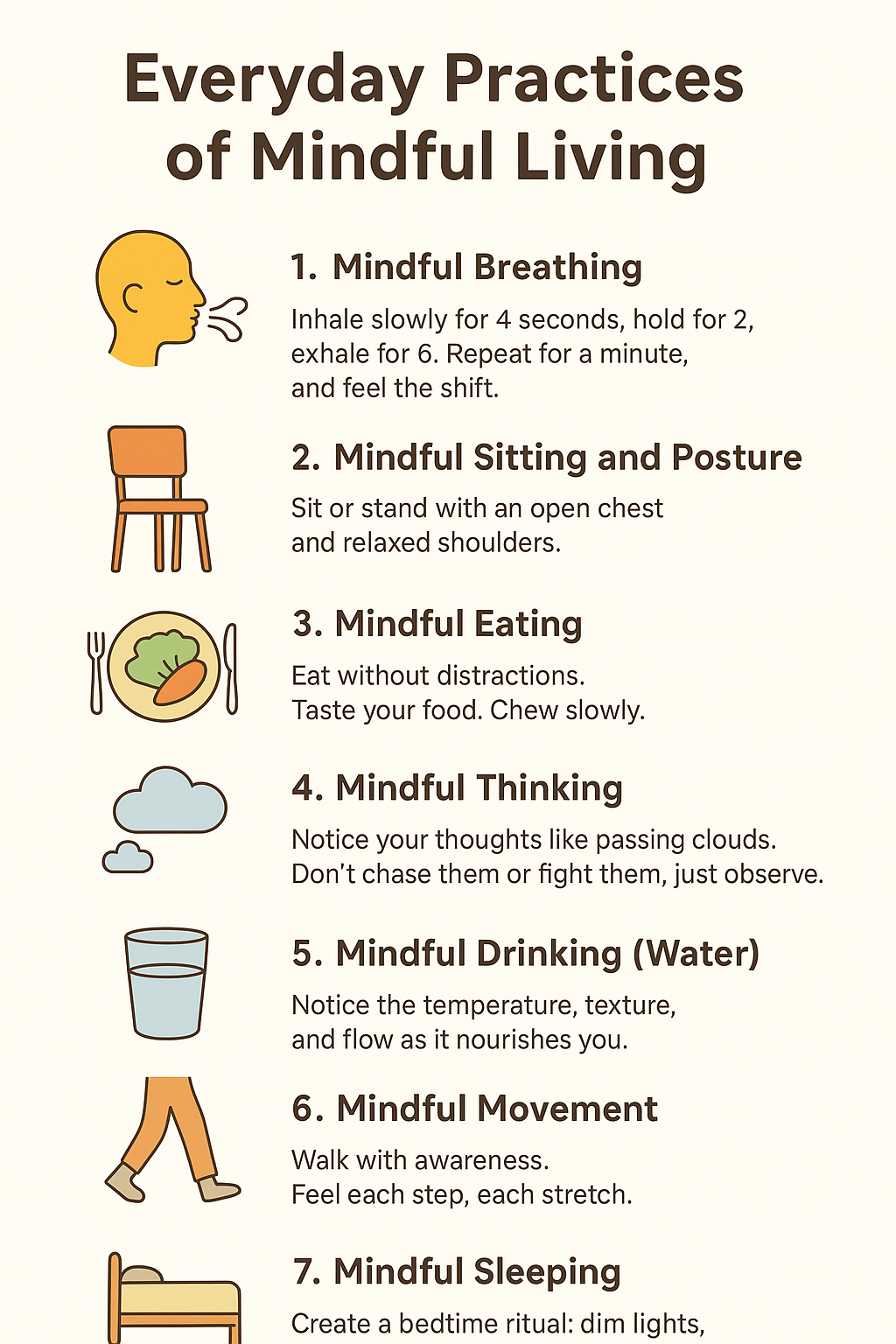
1. Mindful Breathing
Breathing is the bridge between your body and your mind. A few deep, slow breaths can regulate your heartbeat, calm your nervous system, and boost confidence by improving oxygen flow.
Try this simple practice:
Inhale slowly for 4 seconds, hold for 2, exhale for 6.
Repeat for a minute, and feel the shift.
2. Mindful Sitting and Posture
Your posture affects your mood and energy. Sit or stand with an open chest and relaxed shoulders, it allows better oxygen intake and reduces fatigue.
Mindful posture is not about stiffness; it’s about ease and awareness.
3. Mindful Eating
Eat without distractions. Taste your food. Chew slowly. Notice how your body feels before and after each meal. Studies show mindful eating helps regulate digestion, prevent overeating, and improve relationships with food.
4. Mindful Thinking
Notice your thoughts like passing clouds. Don’t chase them or fight them, just observe.
When you catch yourself spiraling, ask: “Is this thought helpful or harmful?”
This small pause changes your emotional direction.
5. Mindful Drinking (Water)
Even drinking water can be mindful. Notice the temperature, texture, and flow as it nourishes you. Hydration becomes an act of gratitude instead of habit.
6. Mindful Movement
Walking, stretching, or yoga, move with awareness. Feel each step, each stretch. Movement is medicine when done with intention.
7. Mindful Sleeping
Create a bedtime ritual: dim lights, avoid screens, breathe deeply. Quality sleep resets both mind and body, one of the purest forms of self-care.
A real life reminder
A 14-year-old boy began experiencing persistent leg pain. Concerned, his parents took him to the hospital where an MRI revealed a mild disc bulge and small protrusion at L4 and L5, pressing slightly on the nerve roots, the source of his pain.
While several factors can contribute to such issues, in his case, the cause was likely poor posture. Hours spent sitting with a bent spine, slouching during screen time, or maintaining an awkward position while studying or driving, all silently strain the back.
This real-life example reminds us that mindfulness isn’t limited to thoughts or emotions, it extends to how we treat our body. Being absent-minded, unbothered, or disconnected from our physical habits can take a real toll. The way we sit, breathe, and move daily reflects how present we are with ourselves.
Mindful living is about bringing awareness to these small, seemingly insignificant moments, because even something as simple as sitting straight, taking a mindful breath, or stretching between tasks can prevent long-term harm and nurture balance in both body and mind.
Benefits of Mindful Living
Mindful living isn’t just a calm moment; it’s a life transformation. Research across multiple studies (NIH, APA, and Mindful.org) confirms measurable benefits, including:
- Reduced stress and anxiety
- Improved focus and memory
- Better emotional regulation
- Lower blood pressure
- Enhanced immune response
- Improved relationships and empathy
Even five minutes of daily mindfulness can make you more aware of your triggers, kinder to yourself, and more present with others.
Mindful Living and Physical Health
Mindful living doesn’t just ease your mind, it nurtures your body too.
When you sit upright, breathe deeply, and move consciously, your blood circulation improves, muscles relax, and posture aligns naturally.
Scientific studies have shown that mindfulness can lower blood pressure, boost immunity, and even help manage chronic pain by reducing the body’s stress response.
It reminds us that health isn’t just about medicine or diet; it’s also about awareness, being present enough to notice what your body needs.
How Mindful Living Builds Emotional Balance
When you live mindfully, you stop reacting from fear or fatigue. You start responding with clarity.
Mindfulness gives you the pause, the breath between stimulus and reaction. It’s that moment where you decide whether to argue, breathe, or simply walk away.
It teaches you to see emotions as signals, not storms, and that awareness becomes emotional strength.
Mindful Living and Stress Management
Stress isn’t the enemy, unawareness is. Mindful living doesn’t remove challenges; it changes your relationship with them. When practiced consistently, mindfulness:
- Lowers cortisol levels
- Improves heart rate variability (HRV)
- Enhances resilience and patience
- Helps you recover from emotional exhaustion faster.
It’s not about controlling life, it’s about flowing through it with consciousness.
How to Start Practicing Mindful Living Today
You don’t need hours or a meditation cushion to begin. Try this:
- Morning minute: Start your day with 3 deep breaths before indulging in any other activity.
- Pause before reacting: When anger rises, pause. Feel the breath before replying
- Eat slowly once a day: Pick one meal and give it your full attention. Be aware of your posture as well.
- Walk mindfully: Leave your phone behind and just notice your surroundings.
- Night reflection: Before sleeping, recall one thing you appreciated today.
Small acts of mindfulness add up, they shape a calmer, kinder, more grounded version of you.
When Mindfulness Feels Hard
There will be days when your mind races and focus feels impossible. That’s okay. Mindfulness is not the absence of thoughts, it’s the awareness that you’re thinking.
Even noticing “I’m distracted” is a mindful act. Be patient. Awareness grows through repetition, not perfection.
Conclusion: Mindful Living Is a Return to Yourself
Mindful living isn’t about slowing down your goals, it’s about showing up fully for them.
It’s learning to pause before reacting, breathe before breaking down, and appreciate life as it unfolds. When you eat mindfully, breathe deeply, and sleep with gratitude, your body finds its natural rhythm again. Stress no longer rules your day; awareness does.
Living mindfully helps you become the calm within chaos, and that calm is what everyone around you silently craves. Start with one small thing today: a deep breath, a slower sip of water, or a kinder thought toward yourself. That’s where mindful living truly begins.
Explore more reflections and guides on MindLiftNow.com — where growth begins with awareness.
Frequently Asked Questions (FAQs)
The goal of mindful living is to become more aware of your thoughts, emotions, and actions, to respond consciously instead of reacting impulsively. It helps reduce stress, improve focus, and bring emotional balance to everyday life.
Yes. Studies show that mindfulness lowers cortisol levels (the stress hormone) and activates the body’s relaxation response. Over time, mindfulness rewires your brain to handle challenges with more calm and clarity.
Start small, take three mindful breaths before you begin your day, notice your food while eating, sit with a straight posture, or walk without checking your phone. Consistency matters more than perfection.
Not necessarily. While mindfulness has roots in ancient spiritual practices, modern mindfulness focuses on awareness, not religion. It’s a practice for anyone who wants peace of mind and better emotional health.
Absolutely. When your mind is calmer, your body rests better. Mindful breathing and relaxation before bedtime can help release tension, slow your heartbeat, and improve sleep quality, which in turn restores your energy levels.
Yes, absolutely. Mindful living doesn’t just calm your mind, it benefits your body too. Studies show that mindfulness can lower blood pressure, reduce chronic pain, and improve immune function. When you sit, breathe, and move consciously, you enhance oxygen flow, posture, and overall energy. In short, a mindful mind creates a healthier body.
Reference:
https://www.health.harvard.edu/heart-health/meditation-offers-significant-heart-benefits
https://pmc.ncbi.nlm.nih.gov/articles/PMC10222936
https://www.health.harvard.edu/blog/can-mindfulness-change-your-brain-202105132455
https://www.apa.org/topics/mindfulness/meditation
https://newsinhealth.nih.gov/2021/06/mindfulness-your-health