
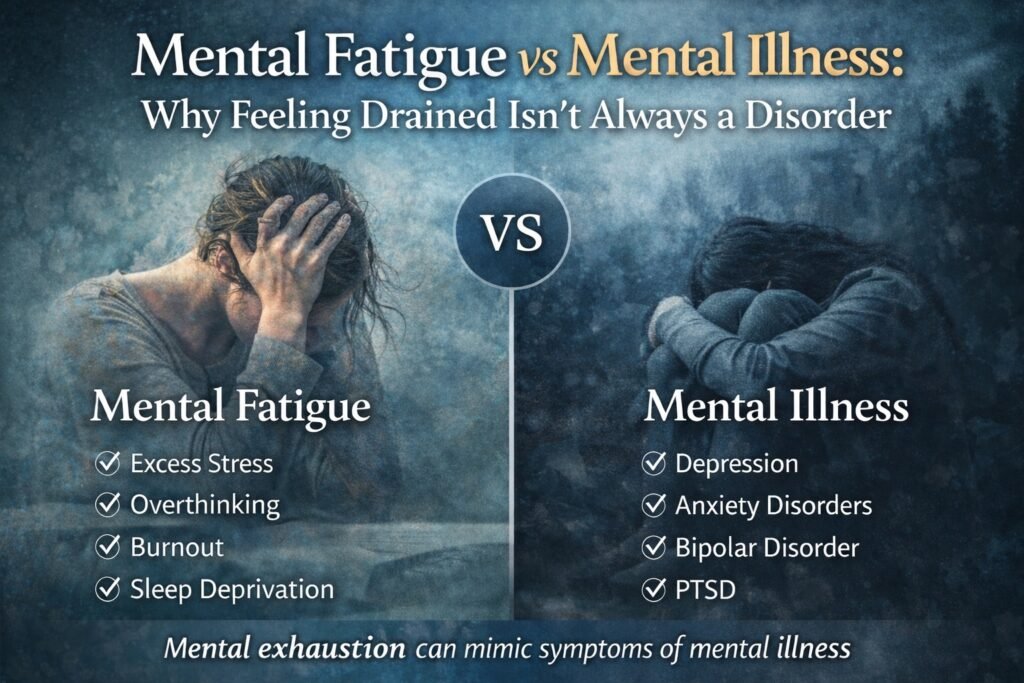
Introduction: When “I’m Tired” Feels Deeper Than Sleep
Have you ever said, “I’m tired,” but what you really meant was “I can’t think, I can’t cope, and I don’t feel like myself”?
That heavy, drained feeling can be scary, especially when it lasts for days. Many people immediately assume something is wrong with them mentally, or they start wondering if they’re developing depression, anxiety, or another disorder.
But here’s the truth: feeling mentally drained doesn’t always mean you have a mental illness. Sometimes, it means you’re mentally exhausted, overloaded, overstimulated, emotionally overworked, and under-rested.
This blog will help you understand the difference between mental fatigue vs mental illness, so you can respond to your mind with clarity, compassion, and the right kind of support.
What Is Mental Fatigue?
Mental fatigue is a state of psychological exhaustion caused by prolonged mental effort, emotional stress, or cognitive overload. It often happens when your brain has been “on” for too long without enough recovery.
Research in cognitive psychology shows that sustained mental effort reduces executive functioning, attention control, and emotional regulation. When the prefrontal cortex becomes overloaded, thinking slows down, and emotional resilience weakens.
You can also explore our guide on burnout and stress recovery to understand how chronic overload affects the brain.
Common Causes of Mental Fatigue
Mental fatigue can build up from everyday life, such as:
- Working long hours without breaks
- Too much screen time or constant notifications
- Emotional stress from relationships or family pressure
- Overthinking and decision fatigue
- Lack of sleep or poor sleep quality
- Academic pressure and constant performance demands
- Caregiving responsibilities
- Burnout from always being “the strong one”
The World Health Organisation’s classification of burnout describes it as a syndrome resulting from chronic workplace stress that has not been successfully managed.
Mental fatigue doesn’t mean you’re weak. It means your mind is carrying more than it can process right now.
Signs You’re Experiencing Mental Fatigue
Mental fatigue can show up in ways that feel surprisingly intense.
Emotional Signs
- Feeling irritable or unusually sensitive
- Crying easily or feeling emotionally “flat”
- Low motivation even for things you enjoy
- Feeling overwhelmed by small tasks
Mental Signs
- Brain fog or slow thinking
- Poor concentration and memory
- Overthinking and mental looping
- Feeling mentally “blocked” or blank
Physical Signs
- Tension headaches
- Heavy body fatigue
- Restlessness, but exhaustion at the same time
- Sleepiness during the day, insomnia at night
Social Signs
- Wanting to isolate
- Feeling drained after conversations
- Avoiding texts or calls because it feels like too much
Mental fatigue often feels like your brain is buffering, like it’s trying to load a life you don’t have enough energy to run.
What Is Mental Illness?
Mental illness refers to clinically significant patterns of thoughts, emotions, and behaviours that affect a person’s ability to function and persist over time.
It isn’t just feeling tired or stressed; it’s a deeper disruption that may require professional treatment and long-term support.
According to the DSM-5 diagnostic criteria published by the American Psychiatric Association, mental disorders involve persistent patterns that cause significant distress or impairment in functioning.
Mental illness includes conditions like:
- Depression
- Anxiety disorders
- Bipolar disorder
- PTSD
- OCD
- Eating disorders
- Personality disorders
It’s important to say clearly: mental illness is real, valid, and treatable. It is not a personal failure.
Mental Fatigue vs Mental Illness: The Key Differences
Let’s break down mental fatigue vs mental illness in a simple way.
1. Duration
- Mental fatigue often improves with rest, reduced stress, and recovery time.
- Mental illness tends to persist for weeks or months and doesn’t disappear just with sleep or a break.
2. Cause
- Mental fatigue is usually connected to lifestyle overload, stress, or burnout.
- Mental illness can come from a mix of genetics, trauma, brain chemistry, and life experiences.
3. Recovery
- Mental fatigue responds well to boundaries, sleep, nutrition, mindfulness, and emotional reset.
- Mental illness often requires therapy, medication, structured treatment, or ongoing care.
4. Functioning
- Mental fatigue may reduce productivity but doesn’t always disrupt identity or core emotional stability.
- Mental illness can affect your ability to work, connect, eat, sleep, or feel safe in your own mind.
Why Mental Fatigue Can Feel Like Depression or Anxiety
This is where most people get confused, and honestly, it makes sense.
Mental fatigue can mimic symptoms of mental illness, such as:
- low energy
- lack of interest
- irritability
- difficulty concentrating
- emotional numbness
- feeling “not okay”
When your brain is exhausted, it can’t regulate emotions properly. That can lead to:
- increased anxiety
- negative thinking
- emotional shutdown
- hopeless feelings
But the difference is this:
Mental fatigue is often a signal that you need recovery. Mental illness is often a signal that you need treatment and support. Sometimes, you may need both.
The Self-Love Truth: You Don’t Need a Diagnosis to Deserve Help
One of the most harmful beliefs people carry is:
“If I’m not clinically ill, I shouldn’t struggle.”
But mental exhaustion is still suffering.
And you don’t need to “prove” your pain to deserve care.
Research on self-compassion by Dr. Kristin Neff demonstrates that treating yourself with kindness improves resilience, emotional regulation, and psychological well-being.
Self-love means learning to say:
- “I’m drained, and that matters.”
- “My mind needs rest.”
- “I can’t pour from an empty nervous system.”
You are allowed to take yourself seriously even before it becomes a breakdown.
When Feeling Drained Is Normal (And When It’s Not)
Feeling drained might be mental fatigue if:
- It started after a stressful period
- You’ve been overworking or overthinking
- You feel better after sleep, rest, or time off
- Your mood improves with connection and recovery
Feeling drained might be something deeper if:
- It lasts more than 2–3 weeks consistently
- You feel hopeless, numb, or disconnected from life
- You can’t enjoy anything, even after rest
- You struggle to function daily
- You have thoughts of self-harm or do not want to exist
If the second list feels familiar, you don’t have to self-diagnose, but it may be time to seek professional support.
How to Recover From Mental Fatigue (Without Guilt)
Here are psychology-backed ways to support your mind when it’s exhausted.
1. Reduce Mental Noise
Your brain can’t heal in chaos.
Try:
- turning off unnecessary notifications
- taking a break from social media
- doing one task at a time (single-tasking)
2. Rest That Actually Restores
Scrolling isn’t always restful; it can keep your brain overstimulated.
Better options include:
- lying down without your phone
- short naps (20–30 mins)
- quiet time with soft music or nature sounds
3. Emotional Decompression
Mental fatigue often hides emotional overload.
Try:
- journaling for 5 minutes
- talking to a trusted friend
- naming your emotions without judging them
4. Move Your Body Gently
You don’t need intense workouts.
Try:
- walking
- stretching
- yoga
- slow breathing exercises
Even a short 10-minute break can support nervous system regulation.
5. Create Boundaries Like Your Peace Depends on It
Because it does.
Boundaries may look like:
- saying no without overexplaining
- limiting access to draining people
- stopping work at a set time
- choosing rest over productivity
6. Use Mindfulness to Reset Your Brain
Mindfulness helps your mind return to the present instead of spiralling.
Simple practices include:
- 3-minute breathing reset
- body scan meditation
- mindful listening (rain, sound therapy, calming tones)
Mental Fatigue Can Become Mental Illness If Ignored
This part matters.
Mental fatigue is not always a disorder, but chronic mental fatigue can increase the risk of anxiety, depression, and burnout if it continues unchecked.
That’s why early care is powerful.
Think of mental fatigue as a warning light, not a diagnosis.
Your brain isn’t broken. It’s asking for support.
When to Seek Professional Help
Please reach out to a mental health professional if:
- Your symptoms feel unmanageable
- You feel emotionally unsafe
- Your exhaustion is constant and worsening
- You can’t function in daily life
- You’re experiencing panic attacks or deep hopelessness
If you feel unsafe or at risk of harming yourself, reach out immediately to emergency services or a crisis hotline where you live.
Conclusion: You’re Not Lazy, You’re Overloaded
Feeling drained doesn’t automatically mean something is wrong with you. Sometimes, it means you’ve been strong for too long, carrying too much, and resting too little.
Mental fatigue is real. Mental illness is real. And both deserve compassion, not shame.
The goal isn’t to label yourself.
The goal is to listen to what your mind is asking for:
Rest. Support. Space. Healing.
And above all: prioritise self-care before exhaustion takes over.
FAQs: Mental Fatigue vs Mental Illness
Yes. Mental fatigue can mimic depression symptoms like low motivation, brain fog, and emotional numbness.
Burnout often improves with rest and boundaries. Mental illness tends to persist and affect deeper emotional functioning over time.
Not always. It can be a temporary response to stress, but chronic fatigue should be evaluated by a professional.
Sleep helps, but true recovery may also require reducing stress, emotional processing, and lifestyle changes.
Yes, if it’s affecting your life or lasting too long. Therapy can help prevent burnout and support emotional regulation.
That’s often brain fog from cognitive overload, stress hormones, poor sleep, or emotional exhaustion.
Yes. When your brain is exhausted, it struggles to regulate fear responses, leading to increased anxiety.
It can be common, but it’s not something you should ignore. Daily mental exhaustion is a sign that you need changes and support.
It can contribute to depression over time if stress is constant and recovery never happens.
Rest, reduce stimulation, hydrate, eat well, reconnect emotionally, and set boundaries even small ones.